THRILLER

THRILLER

Thursday, October 16, 2014

Sound Textual Analysis

Sound Textual Analysis 

The scene which I have chosen to do my sound textual analysis on is the “Everytime” Scene from the American artistic drama called “Spring Breakers” which was released on March 15th, 2013. The film was written and directed by Harmony Korine who is a 41 year old American film director. The film features James Franco, Vanessa Hudgens, Rachel Korine, Selena Gomez and Ashley Benson. To give a little context, the film is about four college aged girls who want go to a party destination for their spring break, they get arrested for something quite insignificant but then they are bailed out by a drug and weapon dealer and altogether “bad guy”, Alien. the girls end up getting sucked into his world of drugs and violence and become part of it them selves.

Spring Breakers (Poster)

The scene starts with ambient sound, you can hear the wind blowing through the leaves of the tree in the shot, and you can hear the sound of waves or flowing water and also the sound of seagulls, this is done as sort of an “establishing shot” but with sound, it lets the audience know where this scene is taking place. With the sounds given to us we can decipher that the scene will be taking place on the ocean front because of the probable personal experience of the audience and thanks to the help of what one stereotypically thinks of when thinking of the sea/ocean we picture seagulls, the sound of the water and the sea breeze. 

As for diegetic sound, you see three of the girls walk out of the house, and so the diegetic sound which you can hear is the footsteps of the girls walking out. You also here the slight clattering of metal at 00:02, as one of the girls grips a gun in her hand, even though it is not very loud it is quite a distinctive sound which you hear a lot in movies, this combined with the movement of the gun which is in the hand of the first girl too walk out of the house is done so that the audience notices the gun in the girls hand; because we here the sound of metal clattering so we look where it is coming from, an our eyes are instantly drawn to the movement of the gun which is the first thing to appear out of the house.

Spring Breakers "Everytime" scene (00:02)

As well, you can here the sound of a Piano being played, at first we are not sure weather this is diegetic or non-diegetic sound. But when the camera pans left at 00:05, it is revealed to us that the sound being heard is actually coming from a piano, which is placed outside and being played by the character Alien. Since we can see the source of the sound in question on screen, this now tells us that the sound we here is diegetic. The piano which is being played starts off quite fast, and as the character Alien see’s the 3 girls exit the house with guns the pace of the piano playing gradually slows down. This seems to be the opposite of the convention normally used in a lot of films, where the music slowly speeds up and gets louder, until the point where something happens, to create suspense. In this case the director has chosen to do the opposite, the piano sound starts off quite fast paced, and as the girls get closer and closer too the piano, the music slows down, synchronously to the gradually shortening amount of space between the 3 girls and Alien. This along with Alien’s facial expressions of slight fear and discomfort, is done to create suspense for the audience, we think that maybe something will happen when the music will stop, so unconsciously the audience start getting worried and apprehensive of what might happen once the music stops. The final note played does not match well with the notes played before, it is a lot lower them, this tells the audience that this is the final note and that something might happen since it is the big finale of this piece.

Spring Breakers "Everytime" scene (00:09)
Spring Breakers "Everytime" scene (00:10)
The next sound we hear is diegetic, it’s voice, one of the girls saying to Alien “play something” she says it rather aggressively like an order, this is emphasised by the gun she is holding. Alien reply’s rather nonchalantly, asking them what they want to hear, and they reply by saying “play something sweet, something uplifting” & “Play something f**king inspiring”. The song which Alien decides to perform is “Everytime” by the American singer & song writer, Britney Spears. 

Britney Spears
Britney Spears "Everytime" Single Cover


Alien starts playing the song at 00:46, some of the lyrics are “Notice me, take my hand”, “Every time I try to fly, I fall without my wings, I feel so small”, “I guess I need you baby”. The connotation behind these lyrics being used at this point in the movie is that these lyrics are very weak, they symbolise being vulnerable, The “notice me, take my hand” lyric sounds like a pled for attention from a scared child, the “I need you baby” and “I feel so small” lyrics show that the person in question cant be alone and needs to be with someone and that they feel small, and the connotations behind small are weak, vulnerable, powerless and because of this probably scared. the girls are dancing and singing along in their cheap, girly, pink tiger bathing suits, their pink, my little poney balaclavas, and their sweatpants with “DTF" on the rear, which stands for “Down To F**k” and  they also have shotguns in hand. This gives avery big contrast between the lyrics and the situation because the lyrics represent someone so weak and helpless yet the girls singing it are dressed so provocatively and violently. What the director has done here is called counter-intuitive soundtrack dissonance, he decided to add music to the scene which was "wrong" or “ill-fitting”, this practice is used to force out an emotion, weather it be sadness or laughter or some other feeling. By creating this sense of unfit it forces the consumers to listen to the lyrics and see the difference between them and what is happening on screen, by doing this, a greater rection from the audience can be achieved in comparison too if a song which did fit with the situation was chosen.

Spring Breakers "Everytime" scene (00:28)
At 01:33 the song goes from being diegetic sound (Alien and the girls singing the song), to non-diegetic sound (the original song “Everytime” by Britney Spears being played). The sound is now non-diegetic because we cannot see the source of the sound on screen, and their is no implication that the characters can hear what the audience is now hearing. The start of this non-diegetic sound triggers a montage which shortly proceed’s (01:55) where the song is being played over the top of it. This montage with the song is the greater continuation of the already started counter-intuitive soundtrack dissonance. This montage is a compilation of shots showing the 3 girls and Alien doing criminal activity and not what the audience would think of when they think of 3 teenage girls. We see shots of violence, for example at 02:10, where one of the girls is holding a mans head between her legs in a rather sexual, provocative and manly manner with a gun to his head. Another violent scene is at 2:19 where the girls seem to be robbing a store at gun point. There are also shots of the girls doing drugs like at 03:46. All these shots of violence, blood, guns and drugs in contrast to this sweat, innocent, vulnerable sounding song which is playing throughout this scene emphasises the already commenced feeling of this song not belonging, and not being the correct song for this scene.

Spring Breakers "Everytime" scene (02:02)
Spring Breakers "Everytime" scene (02:46)

Spring Breakers "Everytime" scene (03:46)
At 04:05 we non-diegetetically hear Alien’s voice whisper “spring break”, it is almost as if he is trying to hypnotise us into wanting to do the same thing, he is reeling in the audience to want to do the same things, as he did to the 3 girls.

Then to wrap up the entire scene, at 04:06 there is a non-diegetic sound bridge with the use of a sound effect in it, which leads from the end of the montage to the start of the final shot in the scene. The sound effect used as a sound bridge is distinctively the sound of a gun reloading which ties back to all the violence in the scene. This sound bridge smoothly transitions to the final shot of the scene  at 04:07 which has only diegetic sound. It is Alien and the 3 girls standing by the water, and Alien shouts “spring break, b**ch’s!” and then they all start firing guns and cheering (diegetic sound). This completely raps up the scene because it talks about the them of the film which is spring break and what it is to them, which is shown by the firing of guns which can be very well heard and echoes throughout the air, for everyone to hear.

Spring Breakers "Everytime" scene (04:09)
In conclusion, I find that this scene from “Spring Breakers” was an excellent scene for sound. It showcased a mix of diegetic and non-diegetic sound, it had a song in it, it had ambient sound, it had a sound bridge which had a sound effect in it, and to finish with what impressed me the most was the fantastic use of counter-intuitive soundtrack dissonance in this scene.

Wednesday, October 15, 2014

Prelim Task

Prelim Task

Part 1

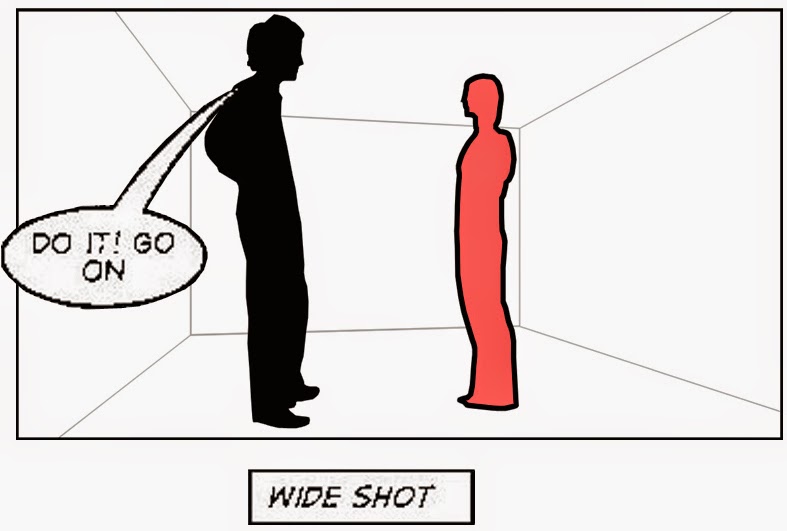
On tuesday the 7th of October when we arrived in class Mike told us that he would once again be bringing us to the film room, he told us to leave all of our stuff in the class and to follow him to the studio; Upon arrival we were told by Matt this class he would not be teaching us anything, but that instead we would be filming something our selves. Matt gave us wo pieces of paper each which looked like this:

Story Board (Page 1)
Story Board (Page 2)


He told us that these were story boards that we would have to try and re-create ourselves, he put four cameras and four tripods on the table and split us into groups, in my group there was myself, Simone, Xalil and Nikita. Right off the bat Simone offered too be one of the two actors/actresses needed, the rest of us wanted to be behind the camera being either the camera man or director but evidently there had too be two actors, so we did the only logical thing left to do, Rock - Paper - Scissors, I lost so I had to be the other actor, Xalil was the camera man and Nikita the Director. 

Next we unpacked the tripod, bubbled it, then unpacked the camera, turned it on and put it on the tripod. Whilst Nikita and Xalil looked at the story board and decided how and where the camera would be set up to try and recreate what was seen on the story board, me and Simone read through  the story board and tried to learn our lines and practice them too each other. We started off by deciding where the scene would take place, we decided that Simone would be the black coloured character on the storyboard and that i would be the pink coloured character on the story board. Simone would come through the main door of the media room and that i would be against the wall which is in front of it, and that Nikita and Xalil would be on the other side of the room and that the 180 degree line would be placed in-between where Simone and I were placed and Where Xalil and Nikita were (Simone to the left of the screen and I to the right). 

Once we were all ready to start filming, we came to the decision that we would start off by filming the Wide Shot’s (WS):


Nikita and Xalil set up the camera facing me and Simone’s sides, like the shot is shown on the story board. the camera was not placed pointing downwards or upwards but simply straight forward as in the storyboard. After we made sure the white balance and focus were correct, and tape was placed on the floor to know where to stand we started filming; We filmed the whole script through because if we filmed only what was shown as Long Shots on the storyboard then it maybe it would not look very natural or like the conversation was flowing, and we know that you cannot film too much only too little, it is always good to have extra footage just incase.

The next shots we filmed were the medium close up (MCU) over the shoulder (OTS) shots:


We started by filming the shots over my shoulder so Xalil set up the camera and Nikita made sure it was perfect with Simone perfectly in focus whilst my shoulder and the side of my head was out focused and not taking up to much of the screen, and of course respecting the 180 degree rule. We filmed the whole script through a few times to make sure we had footage to choose from. We then shot the over the shoulder shots which were over Simone’s shoulder with me as the main subject of the shot and did the same.

We then shot the single character medium close up shots (MCU):


I was the only character in these three shots, and since I am quite tall Xalil had to raise the tripod to be able to get a front facing MCU shot, which was a little to my left so that it wasn't directly in front of me and so that I was not looking right at the lens to show that I am not talking to the camera but to Simone because it was not meant to be a point of view (POV) shot from Simone’s point of view.

Once we had filmed all the scripted shots we decided to film extra shots for extra footage. We filmed shots of Simone’s hand on a door handle opening the door and a shot of Simone’s hand with a phone in it putting it into my hand and a few more shots. We filmed these shots just to add extra footage to make the scene look better on screen.


In conclusion, even though I did not have a chance to work behind the camera as i would have liked too, I still think that the task was good to put too practice what we had learned in the previous classes with Matt and Paul.


Part 2


Thursday, October 2, 2014

Textual analysis of film poster

Textual analysis of film poster

The film poster that I will be reviewing is from the film “The Social Network”. The film was released in 2010, it is categorised as a biography and drama film, it is directed by David Fincher who is an American film director, he was nominated for an academy award for best director for his directing of The Social Network. The Social Network ended up winning 3 oscars and another 149 other wins and 111 nominations, the film was overall rated as very good, a lot of people when to go see the movie, it made £2,486,454 in the U.K on the opening weekend and in total $96,917,897 in gross in the USA, part of the reason why so many people went to go see it was thanks to its  great advertising, and a big part of its advertising was its poster which is regarded as a great poster, it was in IMDB’s list of 20 best film posters of the last 10 years.

The Social Network - Poster

Just to give a little context The Social Network is a biography film of Mark Zucherberg and how he created the website called Facebook. Facebook has become one of the biggest and most used websites of all time and this film is about its creation.

Facebook logo
Mark Zucherberg


The Social Network Poster is quite simple, but it definitively does draw in the audience and grasps their attention. The poster shows the Main character (Mark Zucherberg) played by Jesse Eisenberg who looks like Mark Zucherberg. The poster has the same layout as a lot of film posters, a close-up shot of a face where the eyes can easily be seen, with text that is easily readable over the top of the face and which is in a colour witch catches the viewers attention, mostly white. This layout is commonly used in the film industry for posters.


              Elysium (2013)                                                          Salt (2010)                                                            Thor (2011)


The poster has the same layout as the website the movie is about, Facebook. This and the character which looks like Mark Zucherberg, tells the audience what the film is about but with out giving to much away. The Facebook banner brings a level of familiarity to the audience because Facebook is probably something the audience looks at everyday, so when the audience see’s something they recognise they are drawn in. The obvious target audience for this film is users of the website Facebook, and that is a large percent of the population so it is safe to assume it will draw in a large audience.

Facebook layout on poster.

The character in the poster looks like he is looking at a computer screen because of the lighting on his face which looks electronic and bright and the little square of light in the characters eyes, also the character's blank expression as if he is sitting at a computer, this once again hits at the plot of the film because it is about Facebook and the internet.

Finally, the text on the poster says “You don't get to 500 million friends without making a few enemies”. The text is written in different fonts (mostlly “Bebas Neue”) and different sizes, but all very large, it is also written in a bright colour (white), all this draws the audiences attention to the poster to read what is written. The meaning behind the tag line is that face book has an immensely large amount of users, at the point of the movie around about half a billion users which is about 15% of the worlds human population, they are calling these Mark Zucherberg’s friends because he created this website that everyone is using, and it says that you cannot get to that level of success without making a few enemies. This draws in the audience and they will want to see the movie and find out how he makes these enemies.

Writing & Font used on The Social Network Poster

Too conclude, this poster draws in the the viewer to the poster in various different ways, it also gives the viewer a sense of familiarity, so the audience is drawn to the poster and then see something they like and they recognise and are interested in, and this will lead the viewer to go watch the movie; So the poster full fills its job of convincing the audience to go watch the film.

Camera Class 2

Camera Class 2


PART 1

Last Thursday (25th of September) Mike (my teacher) brought us back to the film room for another camera class with Matt and Paul. There was camera set up next to a monitor which was showing what could be seen on the camera screen, so that we could see what was being filmed. Matt got on the floor with the camera and a phone in the shape of a Ferrari car. He showed us how if the car phone was driving in one direction down a line, the camera had to stay on one side of the line because if we took one shot where the car was moving it and we were filming from the left side and then another shot of it moving on the right side then it would look like there were two cars driving in opposite direction rather than one car driving in one direction. This is called the “180 degree rule”.

The “180 degree rule” creates some sort of an imaginary axis between the camera and the actors/objects being filmed. The camera should stay on one side of that axis (180 degrees of the full circle which is on the axis, hence the 180 degree rule) and the actors/objects on the other, if the camera were to cross the axis and go to the other side then it would look like suddenly the actors/objects have switched positions, the actors/objects on the left would now appear to be on the right and the actors/objects on the right would appear to be on the left. This is done to allow audience to never get confused as to where the actors are situated on the set and in relation to each other.

180 degree rule (diagram)

The 180 degree rule is followed in most films because the director does not want to to confuse the audience, it simply makes sense and looks a lot better, if a Director were too not follow the 180 degree rule then it would be quite some awkward cuts which would leave the audience disorientated and lost in terms of the characters positioning.

His Girl Friday (1940)

In some instances though some directors decide to break the 180 degree rule on purpose to possibly give across a certain effect. One director who was notorious for often breaking the rule was the Japanese director Yasujiro Ozu, he apparently did this because he wanted to make his films different from the norm and to try and trick the audience and make them feel tricked for comedic reasons or to ease tension. A famous movie which had a breaking of the 180 rule was The Shinning, Stanley Kubrick broke the rule to try and give across a surreal feeling in the scene.


Late Spring (1949)

The Shining (1980)


PART 2

Later on in the class, Matt and Paul brought back out the tripods and camera’s from the last class we had with them. Are challenge was to shoot a short simple clip which included many of the shots we had learnt in class with Mike. 


Long Shot (LS)
Medium Shot (MS)


Extreme Close Up (ECU)
Close Up (CU)


The scene which my group decided to film was of a girl going up to a chair from out of shot, then she lifts her foot up onto a chair, does up her shoelaces on one shoe, and then walks out of shot. We used a Long Shot (LS) for when the girl was walking up to the chair so that we could see her whole body and the untied shoe, we used a Mid Shot (MS) for when the girl was bending down, we then used a Big Close-Up (BCU) of the shoe and the shoe laces being tied, next a Close-Up (CU) of the girls face while she was tying the shoe and then finally a Medium Long Shot (MLS) of the girl walking out of the shot.

To conclude, in the class my knowledge of the 180 Degree rule was refreshed and put to the test which I found useful and helpful because it had been a while since I had looked at the technique. Then we also got to actually film shots that we had learned about in class, this was nice because it was the first time we were really filming something with the school camera’s, we could actually see how footage filmed with the camera turned out which was nice to finally see.

Friday, September 26, 2014

Analysing and comparing three opening sequences.

Analysing and comparing three opening sequences.


In this blog post I will be analysing three opening sequences and later on comparing them between each other. The opening sequences I will be reviewing will be from firstly the movie “The Shining” then “Drive” and finally “Lord Of War”. I will be looking at camera angles, the connotations created and the effect on the audience and simply the over all feel of the intro.

The first film intro I am going to review is the intro to “The Shining”.

The Shining, (POSTER), 1980

The Shining is a horror film released on my 23rd, 1980, it was Directed by Stanley Kubrick. Stanley Kubrick was an American Director who died in 1999, only 19 years after the release of “The Shinning”. 

Stanley Kubrick

The Intro to “The Shinning” was shot on The Going-To-The-Sun road, located in Glacier National Park, Montana. The first shot is an extreme long and is also an establishing shot, it allows the audience to have an idea of where the film is and will be taking place. The whole intro is shot from a helicopter so it is all low facing shots. The first shot is a shot taken from the helicopter going over a lake, in the middle of the lake there is an island, an island gives a feel of isolation and loneliness so there is probably a reason why Stanley decided to put that as the first shot of the film. Most of the opening scene from about 00:20 is a tracking shot of a yellow car which most probably belongs to the main character/s, the yellow colour of the car makes it easy to follow and fix your eyes on while it drives along the road. 

The shot shows mainly the nature around the car, showing that they are in a empty place where it is mostly nature and there are no people. This makes the viewer feel the feeling of isolation, the same with the island in the first shot, with no one being around it gives the audience the feeling that something bad might happen because the thought of being alone somewhere far away from civilisation is scary. Along with this the music definitely adds to the whole sinister and lonely effect that the cinematography puts across, instruments like violins, guitars, and piano are played in the music. You could play happy and joyful music over this footage and it would look normal, its the type of footage which doesn't set the mood itself, it needs the music to be able to give across the mood which the director is trying to put across.

The Shining: (0:11)
The Shining: (0:45) 


From the beginning too the end of the opening sequence the car travels from the bottom of the mountain and as the sequence continues the car travels up the mountain and by the end the car reaches what seems to be the top of the mountain where there is a hotel, then that is the end of the sequence. There is a high angle used to show the car driving on a empty road. With this angle being used the car looks miniature compared to the surrounding. The surrounding in this mainly big trees, large mountains, and a lot of water which again emphasis the effect of isolation and makes the car small in comparison to there surroundings so this also makes them look vulnerable. This also puts across a feeling that the car is getting farther and farther from civilisation and society, and this brings us back to the feeling of loneliness, which as I explained before is scary, people don't like being alone. one thing that came into my head during the opening sequence is a question I've heard before "If a tree falls in a forest and no one is around to hear it, does it make a sound?” which is sort of scary because it is sort of the same thing as if anything were to happen to the people in the car through out the movie, they are in the middle of nowhere and it would be hard to get help.

The Shining (0:45)
The Shining (1:05)


The Shining: (2:24)
The Shining: (2:41)


Along the route that the car travels you see a few peculiar things for example at 1:52 you see what seems to be a police car with open doors, this is discomforting to the viewer, the audience thinks something bad might be going on, the audience doesn't actually have a clue if anything bad is going on but along with the sinister music it adds to the whole scary feeling which is building up through out this opening scene. Another thing I noticed Is that every other car you see (1:55 & 2:15) seems to be driving away from where the car is heading, this might simply be a coincidence but now that i re-watch the opening sequence and notice the police car and all the cars leaving from where they are going it does add too the “creepy” feeling the opening scene puts across.

The Shining: (1:52) Police car.
The Shining: (2:15) Car driving away.


The titles in this opening sequence are in a bright colour (turquoise), the titles are also in the middle of the screen. This draws the audiences eyes to the titles so that they read the names which is the point of the titles. I wouldn't describe the titles as “scary” though, which works against the sinister music and feeling which has been building up, I think this done to reassure the viewers in a way.

The Shining: (2:13)

At the end there is an establishing shot of a big hotel looking building because of its size and the fact that there are quite a few cars parked outside. With the Rocky Mountains in the background. Since it is the last thing the audience see’s and the shot is an establishing shot it lets the audience know that this is where the film is going to be taking place.

The Shining: (2:41)

All together I think that this opening sequence was relatively effective because it gave across the sinister feeling of the film, it makes the audience want to know what is going to happen in this big hotel, so this makes the viewer want to keep watching. Personally I didn't find it to attention grabbing or exciting, I got a little board of it by the of the sequence. So to end I do believe it was quite an effective opening sequence but definitely not the best I've scene.

If you would like to see the opening sequence to The Shining for your self, here is the link:
http://www.youtube.com/watch?v=kiV3J_e977Q


The second opening sequence that I will now be reviewing will be “Lord of War”.

Lord of War is a war film directed by Andrew Niccol who is a director, producer and screenwriter from New Zealand. The film was released on September 16th of 2005. The intro to this film is quite a good one, which is why I picked this movies intro because it is one I think is well done and is effective.

The movie starts off with a bang.. literally. The films opening scene for this movie is about the life of a bullet from being first created all the way up to being shot. 

The first shot of the scene, is a shot inside a placatory which seems to be probably somewhere in eastern Europe, my guess would be Russia because of the communist star we see on the machine at 0:08. The camera then pans down from the ceiling and zooms into a small part of a machine and the camera goes into the machine and starts following some bullets on there way down a production line as if it was a bullet itself. At 0:39 the camera attaches itself to the back of the bullet, almost as if it is a POV shot from the point of view of the bullet, the shot is like this all the way up to about 2:53 only 8 seconds away from the end of the opening sequence. We ride with the bullet throughout the process of being made through the factory until 1:28 where the box is wield and we can here noises as if it is being transported somewhere, then at 1:30 the box is opened and a seemingly Russian man (because of his Russian uniform), this man is standing next to docks where there is water and big transport boats so when the man closes the box at 1:35 again, this makes the audience think that the bullet will be once again transported. This is very effective in catching the attention of viewers because now the audience wants to see what the next step in the life of this bullet will be so this draws in the audience and makes them want to watch more of the movie.

When the box is opened again at 1:41, we see that it seems to be at another dockyard but this time in an unknown African country. The men which we see are quite heavily armed, one of the men even seems to be holding a rocket launcher, the men are dressed in what seems to be stereotypical African uniform so that the viewer really understands that the bullet has arrived somewhere in Africa.

The box with our bullet is then hit by a crane and the bullet falls out of the case, the bullet flies through the air and hits the ground, when the bullet rolls on the floor at 1:47 we see that when ever the bullet is upside down it is slightly elevated of the floor, and when it rolls over on to its bottom side it seems to be right on the floor, I think that the director wanted to really make it look like there is a camera attached to the bullet but do it in a discrete way, so when ever the bullet is upside down it is the small lens of the camera holding up the bullet and it is the camera touching the floor, when it rolls over onto its bottom side it is the bullet against the floor, this is done to make the viewer think that there really is some sort of small camera attached to the bullet. the bullet keeps rolling until we see it seem to bye rolling closer to the edge of the peer where we think it might fall in the water, this is a small little part to build a little bit of tension, wondering if the bullet will fall in the water or not, it isn't the most worrying thing but it does help to build tension in the opening sequence. The bullet is right by the edge of the water, about to fall in but then it gets rescued at the last second by a man who picks up the bullet and throws it back into the box with the rest of the bullets.


The box full of bullets is then loaded onto a truck, when the box is placed down on the truck the bullet get shaken and it points downwards into the box and it is pretty much all dark, this is how the director makes transitions in this opening sequence, it will go from a shot of what ever is going on then the shot will get dark in ways like putting a lid on the case or simply pointing the bullet downwards into the box and when the bullet is back up at the surface it will be somewhere else. In this case when the bullet points back up, it is now on the truck in what seems to be some sort of a forest/jungle type surrounding with two African soldiers with AK47’s and rocket launchers. (An example of the transition is shown with pictures bellow).